
OpenLabs
Four desktop-class creative apps in the browser: 3D modelling, image editing, DJ mixing, and feed planning
3/4creative apps live on custom domains
The idea
Creative software asks for two things before it does anything useful: an account and an upload. Both are there for the vendor, not for you. Browsers have been able to do the actual work for years, and almost nobody builds that way.
OpenLabs is four applications built from the same shared parts, with one rule: everything runs on the user's machine. No sign-up, no server round trip, no file leaving the tab. Each can be installed and keeps working when the network is off.
The four
OpenSketch is a 3D modeller in the shape of SketchUp. Underneath it uses proper connected geometry rather than a bag of separate triangles, which is why push/pull, follow-me and offset actually work. It snaps to endpoints, midpoints, edges and axes, has four render styles, and exports to glTF, GLB, OBJ and STL.
OpenPaint is a raster editor: layers with blend modes, brush and shape tools, rectangular, lasso and magic-wand selection, gradients, text, and a hundred-step command history. Its AI features (background removal, sketch to image, layer splitting) run against a key you paste in yourself.
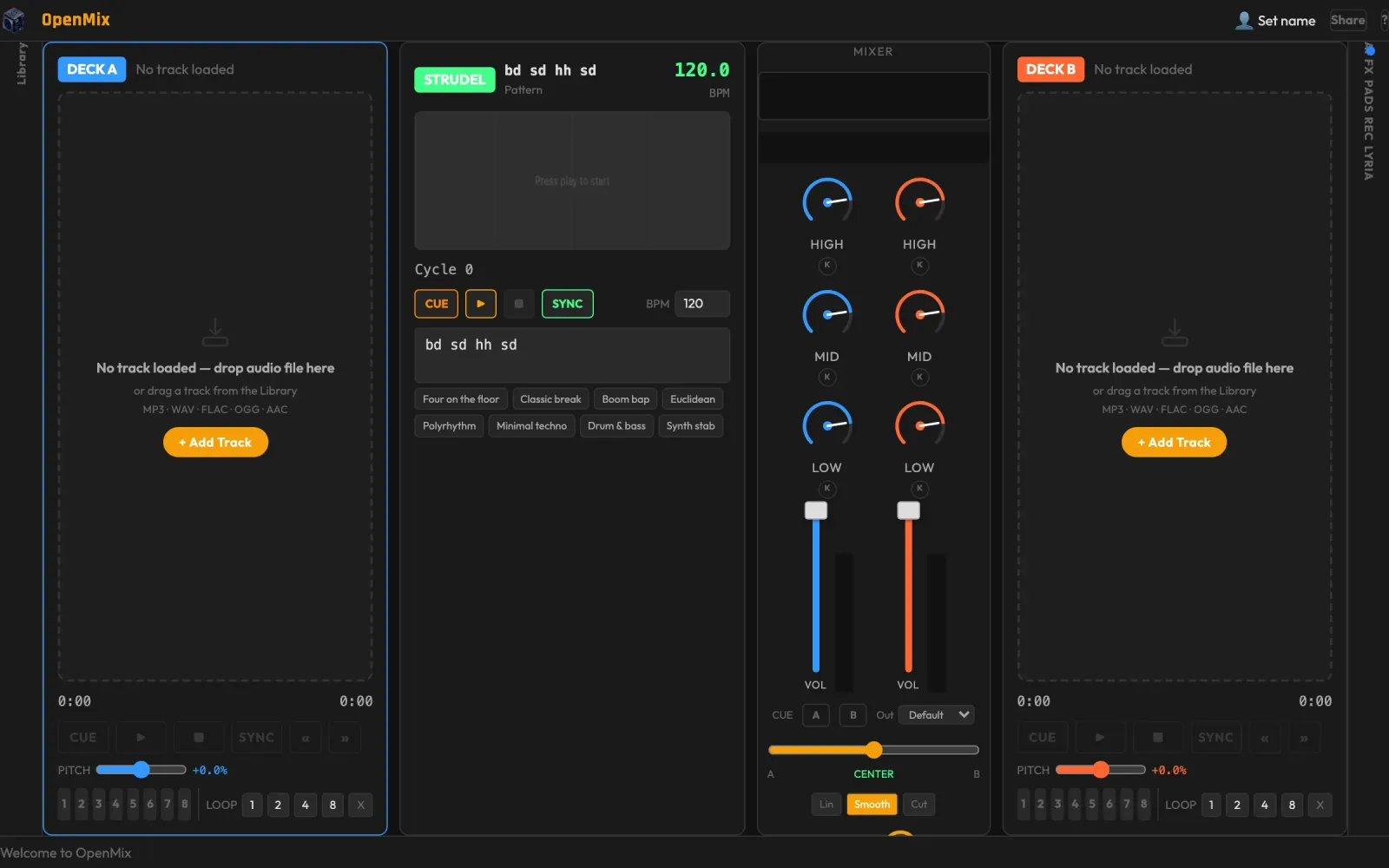
OpenMix is a two-deck DJ mixer. It detects each track's tempo and musical key on your machine and shows which tracks mix well together. It has per-deck reverb, delay, filter, flanger and phaser, records the mix, plays live-coded drum patterns through Strudel, and can generate music with Lyria.
OpenBrand plans an Instagram grid inside a phone mockup, with a local image library in IndexedDB and a plan you can compress into a URL hash and send to somebody.
The shared spine
Four apps with the same problems are worth building from shared parts. Undo and redo work the same way in every app. The AI assistant is one panel that talks to Claude, OpenAI or Gemini, with the key encrypted locally and never sent anywhere but the provider. The file dialogs, settings, keyboard shortcuts and offline support are shared too.
The constraint that everything is client-side is what makes the whole thing cheap to run and, more usefully, what makes it honest: there is no server that could be looking at your files, because there is no server.